Table of Contents
ToggleKey Takeaways
Government schemes can make loans easier by reducing risk for banks and lowering costs for borrowers.
Support is helpful, but EMIs are your responsibility. You still need to meet eligibility rules and prove repayment capacity.
Different schemes are designed for different needs, such as business setup or growth, home purchase, farming requirements, or education funding.
Introduction
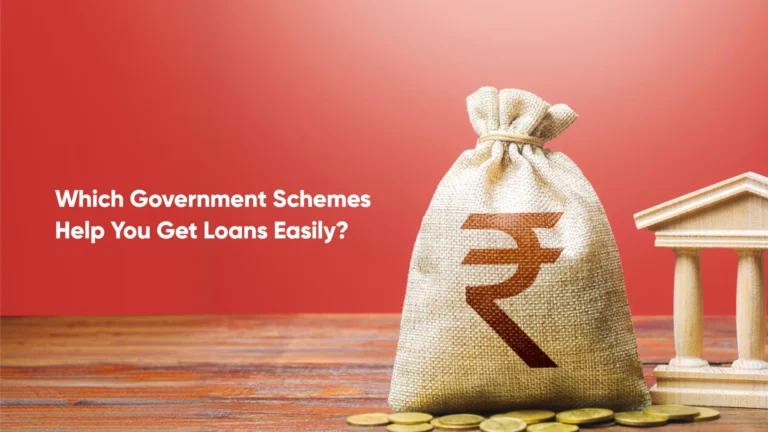
Getting a loan can feel hard when you are new to credit, have a small income, or do not have collateral. That is exactly where government loan schemes can help. These schemes try to make credit more accessible for people who may otherwise get rejected or get costly offers.
In this guide, you will learn what each scheme is meant for, who it helps, and what to keep in mind before you apply.
How Government Schemes Support Easier Access to Loans
Many government programs work like a bridge between borrowers and lenders. They do not directly “give” money. Instead, they make it easier for banks and financial institutions to lend to you.
Credit support for different income groups
Different schemes serve different needs. Some support micro businesses and self-employed people. Some are meant for farmers. Some support students or first-time home buyers. This targeted approach helps lenders judge your application based on the scheme’s purpose, not only on traditional factors like collateral.
For instance, a small shop owner and a salaried home buyer have different needs for taking a loan. These schemes are designed with those differences in mind.
Role of subsidies and guarantees
A subsidy reduces your cost, usually by lowering the effective interest burden. A guarantee reduces the lender’s risk, so they may lend even if you cannot provide security. This is why government loan schemes often feel “easier” than regular loans, especially for first-time borrowers.
Pradhan Mantri Mudra Yojana (PMMY)
Pradhan Mantri Mudra Yojana (PMMY) is built for small business financing. It supports micro enterprises so they can start, run, or expand without getting stuck at the “no collateral, no loan” stage.
Who can apply under Mudra
You can apply if you run or start, a micro business in manufacturing, trading, or services. Think of local businesses like a tailoring unit, small grocery store, salon, cloud kitchen, or a repair shop.
Mudra loans are offered through banks and eligible NBFCs. If you prefer a digital route, many lenders let you apply for a Mudra loan online through their website or app, though steps can differ by lender.
Types of Mudra loans
Mudra loans are usually offered in three buckets, based on the business stage and required amount [1]:
- Shishu: for very small funding needs, often for starting out
- Kishor: for a business that is running and needs growth capital
- Tarun: for larger expansion needs within the Mudra limit
The goal is simple: to match the loan amount with your business maturity, so you borrow responsibly and repay comfortably.
Pradhan Mantri Awas Yojana (PMAY)
PMAY supports affordable housing. If you qualify, the scheme can reduce your home loan burden through an interest subsidy. Recent government data shows that over 1.22 crore houses have been sanctioned under PMAY-U and PMAY-U 2.0, with more than 96 lakh already completed and over 94 lakh occupied. [2]
Home loan interest subsidy
Under the Credit Linked Subsidy Scheme, eligible borrowers may get a subsidy that lowers the effective interest cost. This can reduce your EMI or your overall interest outgoing across the loan tenure. This matters most when your budget is tight, as it gives you space to manage expenses comfortably.
Eligibility criteria
Eligibility depends on your income category, property ownership status, and other scheme rules. In many cases, the benefit is meant for people buying their first home. Banks also evaluate your repayment capacity before approving the home loan.
Stand-Up India Scheme
Stand-Up India encourages entrepreneurship among women and SC and ST borrowers. It is focused on helping new businesses get formal credit. ₹30,160 crore has been sanctioned under Stand-Up India to 1,33,995 loan accounts (as of 21 Mar 2022) [3]
Who the scheme is for
The scheme primarily supports women entrepreneurs and borrowers from SC and ST communities who want to start a new business venture.
If you already run a business, you may still explore it for new projects, but the core intent is to support greenfield enterprises.
Loan purpose and limits
Loans can be used for setting up a new unit in manufacturing, trading, or services. The loan range is typically higher than micro-loan products, and lenders also look at project feasibility. You should be ready with a clear plan for how you will use the funds and how the business will generate income to repay the loan.
Kisan Credit Card (KCC)
KCC is designed for farmers to access timely credit for agricultural needs. It reduces dependence on informal borrowing.
Eligibility for KCC loans
Farmers who cultivate land, tenant farmers, and some allied activities like dairy or fisheries may be eligible, depending on the lender’s rules and local guidelines. Banks usually check your farming activity, land records or related proofs, and repayment capacity.
Uses of Kisan Credit Card
KCC credit can support expenses like seeds, fertilisers, irrigation, and other seasonal needs. Since farming income can be seasonal, KCC is structured to match the cash flow cycle better than a regular loan.
Credit Guarantee Fund Scheme (CGTMSE)
CGTMSE helps micro and small enterprises by offering credit guarantee cover to lenders. This improves the availability of collateral-free business loans.
How credit guarantee works
A credit guarantee means a part of the lender’s risk is covered by the guarantee trust. So, if a borrower defaults, the lender may get partial compensation, as per scheme rules. This risk cover encourages lenders to approve loans where collateral is not available, especially for small businesses.
Benefits for small businesses
The biggest benefit is improved access to credit. It can also support first-time entrepreneurs who have skills and demand but do not have assets to pledge. This is another example of how government loan schemes reduce friction between small borrowers and formal lenders.
National Minorities Development & Finance Corporation (NMDFC)
NMDFC focuses on providing financial support to eligible individuals from minority communities who fall under the income criteria.
Eligible beneficiaries
Eligibility usually depends on community category and income limits set under the program. Applicants may need to apply through partner agencies or state-level channels.
Types of loans offered
NMDFC supports different loan needs, including self-employment, small business support, and education-related funding in some cases. The purpose is to enable livelihood and income generation through affordable credit.
Education Loan Schemes Backed by Government
Education loans can support higher studies in India or abroad. Some government-backed support focuses on reducing interest burden during the study period.
Interest subsidy schemes
Interest subsidy schemes typically cover the interest during the moratorium period for eligible students from economically weaker backgrounds. A moratorium is the period when you study and may not need to start EMI immediately.
This support reduces the pressure on families during the course years.
Repayment support features
Education loans often come with flexible repayment structures. Many lenders offer a grace period after course completion, so the borrower can start repayment after getting a job.
Still, you should borrow carefully and estimate your future EMI before committing.
Things to Know Before Applying for Loans Under Government Schemes
Before you apply, treat this like any other loan decision. The scheme can help, but it cannot replace basic financial planning.
Eligibility and documentation
Start with a simple checklist: confirm you fit the scheme category, then collect the right documents. Most applications need identity proof, address proof, income details, bank statements, and a clear purpose. Business loans may require a basic plan or cash flow estimate.
If you are exploring entrepreneurship support, you may also come across options like a pmegp loan. Always verify the exact eligibility and process with the official channel or the bank branch handling it.
Repayment responsibility
Even when a scheme offers subsidy or guarantee, repayment remains your duty. Missing EMIs can hurt your credit score and make future borrowing harder. Borrow only what you need, choose a realistic tenure, and keep your EMI within your monthly budget. This mindset will help you use government loan schemes wisely, not just quickly.
Sources:
[1] https://www.ujjivansfb.bank.in/banking-blogs/msme-loan/complete-list-of-government-msme-loan-schemes
[3] https://www.pib.gov.in/PressReleasePage.aspx?PRID=1813432
Frequently Asked Questions (FAQs)
Which government scheme makes it easier to get a loan?
Pradhan Mantri Mudra Yojana, or PMMY, often makes access easier for micro businesses by supporting small ticket business loans.
Are government-backed loans guaranteed to be approved?
No. Lenders still check eligibility, documents, and repayment capacity before approving any loan.
Can salaried individuals apply for government loan schemes?
Yes. Salaried borrowers can apply for schemes like Pradhan Mantri Awas Yojana, or PMAY, if they meet the income and other criteria.
Do government schemes offer lower interest rates?
Yes, sometimes. Some schemes offer interest subsidy or concessional benefits, but the final rate still depends on eligibility and the lender.
What documents are required for government scheme loans?
Most government schemes ask for identity proof, address proof, income details or bank statements, and purpose-related documents like a business plan or admission proof.