
Table of Contents
ToggleKey Takeaways
- ABHA stands for Ayushman Bharat Health Account.
- It’s a unique 14-digit health ID. It helps you link, access, and share health records digitally.
- Creating an ABHA card is free.
- ABHA is voluntary and is not the same as health insurance.
Healthcare paperwork can become tough to keep organised. One doctor asks for an old prescription, another needs a test report, and suddenly, you are searching through WhatsApp images, PDFs, and your old files. To understand the meaning of an ABHA card, think of it as a digital health ID that helps connect your medical records in one place.
An ABHA card helps solve this problem by giving you a digital health account where your medical records can be linked and shared with your consent. Here is a simple guide to know what it means, who can apply, and how to create one online.
What is an ABHA Card?
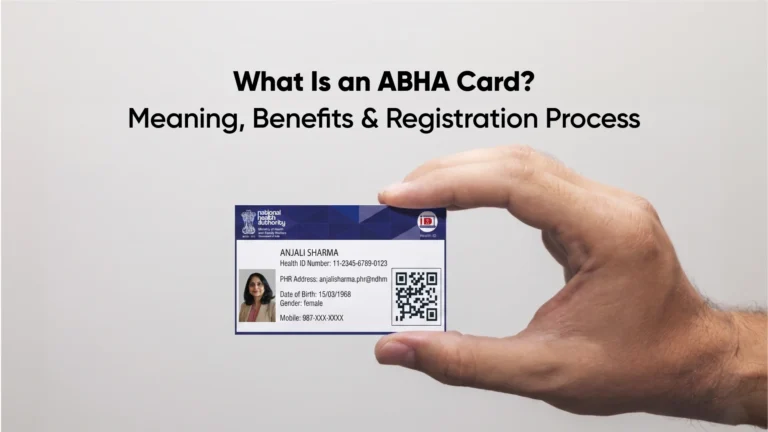
An ABHA card is a digital health ID created under the Ayushman Bharat Digital Mission. It gives you a unique 14-digit ABHA number that can identify you across India’s digital healthcare ecosystem.
In other words, it helps you keep your health records connected to one digital system. These records may include prescriptions, lab reports, diagnosis details, discharge summaries, and other medical documents from ABDM-enabled healthcare providers.
What is ABHA (Ayushman Bharat Health Account) and How Does It Work?
ABHA works as a digital link between you and your health records. When you visit a hospital, clinic, lab, or healthcare provider that supports ABDM, you can share your ABHA number or ABHA address.
Your records can then be linked to your ABHA account, but only with your consent. Official ABDM material explains that users can share selected health records, and that consent does not need to apply to all records at once.
For instance, if you visit a doctor in Mumbai today and later consult another doctor in Pune, your linked records can help the second doctor understand your medical history better, without you carrying a physical file.
Benefits of Having an ABHA Card
The biggest benefit of an ABHA card is easier access to your health records. You do not need to depend only on paper prescriptions or scattered reports. If your healthcare provider is part of the ABDM network, your records can be linked digitally.
It can help you:
- Access prescriptions, lab reports, and diagnosis records digitally
- Share medical history with doctors with your consent
- Avoid repeating the same health details at every visit
- Keep long-term health records organized
- Use ABDM-enabled apps to view and manage records
- Reduce the risk of losing important medical documents
ABHA can be especially useful for people managing chronic health conditions, elderly family members, frequent consultations, or long-term treatment.
Who Can Apply for an ABHA Card?
Any Indian citizen can create an ABHA card. There is generally no age-based restriction, and parents or guardians can help create one for children. There is no restriction based on age, caste, or income.
However, ABHA is voluntary. You can access healthcare services without creating an ABHA account, although having one may make health record access easier.
Who should create an ABHA health card?
Anyone who wants to keep their medical records better organised can create an ABHA health card. It is voluntary, which means you can choose whether or not to create one.
An ABHA health card can be especially useful if you:
- Visit doctors, clinics, or hospitals often
- Get regular lab tests or health check-ups
- Manage long-term conditions like diabetes, blood pressure, thyroid issues, or heart-related concerns
- Consult different doctors and want your medical history to be easier to access
- Manage health records for elderly parents, children, or family members
For example, if your parent visits different doctors for ongoing treatment, ABHA can help keep prescriptions, lab reports, and discharge summaries linked digitally, provided the healthcare provider supports the ABDM system.
However, an ABHA health card is not health insurance and does not give free treatment by itself. Its main purpose is to help you access and share your health records digitally, with your consent.
Documents Required for ABHA Card Registration
Any Indian citizen can create an ABHA card. There is generally no age-based restriction, and parents or guardians can help create one for children. There is no restriction based on age, caste, or income.
| Requirement | Purpose |
|---|---|
| Aadhaar Number | Used for identity verification |
| Aadhaar-Linked Mobile Number | Required for OTP verification and account access |
| Driving Licence Details | Can be used as an alternative to Aadhaar-based registration |
| Basic Personal Details | Includes name, date of birth, gender, and address information |
If your mobile number is not linked to Aadhaar, you may still explore the driving license option or assisted registration through supported healthcare facilities.
However, ABHA is voluntary. You can access healthcare services without creating an ABHA account, although having one may make health record access easier.
How to Create an ABHA Card Online (Step-by-Step Process)
You can create your ABHA card online through the official ABHA portal or an ABDM-enabled app.
Here is the simple process:
- Visit the official ABHA website.
- Click on Create ABHA Number.
- Choose Aadhaar or driving license for verification.
- Enter the required ID details.
- Verify using OTP.
- Add or confirm your mobile number.
- Create your ABHA address, if prompted.
- Once generated, download your ABHA card and save it on your phone.
Your ABHA card will show your unique ABHA number and basic details. Download ABHA card as a PDF on your phone so you can access it when needed.
How to Link and Access Your Health Records Using ABHA
Creating an ABHA card is only the first step. To make it useful, you need to link your health records. Once your ABHA card is created, the next step is to link your health records so you can use it properly.
When you visit an ABDM-enabled hospital, clinic, lab, or healthcare provider, you can share your ABHA number or scan a QR code where available. The provider may ask for your consent to link or share your records.
Once linked, you can use an ABDM-enabled personal health record app to view, manage, and share your medical records. You can also control who gets access and for how long. Official ABDM material says health records are not centrally stored by ABDM; they stay with the healthcare providers where they were created, while ABDM enables secure exchange with consent.
ABHA does not mean every doctor can automatically see your complete medical history. Your health records are shared only after your consent, and you can choose which records to share.
Is ABHA Card the Same as Ayushman Card?
No, an ABHA card and Ayushman card are not the same.
An ABHA card is a digital health ID that helps you link and access your health records. An Ayushman card, often called the Golden Card, is linked to PM-JAY health coverage for eligible beneficiaries.
So, an ABHA card does not automatically give you ₹5 lakh health insurance or free treatment. It mainly helps you manage and share medical records digitally.
| Feature | ABHA Card | Ayushman Card |
|---|---|---|
| Main purpose | Digital health record ID | Health coverage under PM-JAY |
| Who can get it | Any individual can create ABHA | Only eligible PM-JAY beneficiaries |
| Free treatment | No automatic free treatment | Coverage available for eligible families |
| Main use | Link and share health records | Access covered hospitalisation benefits |
Conclusion
An ABHA card is a useful digital health ID for anyone who wants easier access to medical records. It helps you link prescriptions, reports, and health documents in a more organized way and share them with healthcare providers when needed.
The most important thing to remember is this: ABHA card does not mean health insurance and does not automatically give free treatment. It is a digital health account that supports easier, consent-based access to your health records.
If you often visit doctors, manage family health records, or want a cleaner way to store medical history, creating an ABHA card can be a practical option.
Frequently Asked Questions (FAQs)
What is an ABHA card used for?
An ABHA card is used to link, access, and share your digital health records with healthcare providers, based on your consent.
Is ABHA card free to create?
Yes, creating an ABHA card is free of cost. Any individual can generate an ABHA under ABDM without paying a fee.
Who is eligible for ABHA card?
Any Indian citizen can apply for an ABHA card. There is no income-based restriction.
How can I register for an ABHA card online?
You can register through the official ABHA portal by choosing Aadhaar or driving licence verification, completing OTP authentication, and downloading your card.
Is ABHA card mandatory in India?
No, ABHA is voluntary. Some hospitals may encourage it for easier digital registration, but ABHA itself is not mandatory for everyone.
Can I update details in my ABHA card?
Yes, you can update certain profile details such as mobile number or email through ABDM-enabled apps or the official ABHA platform, usually with OTP verification.
Is ABHA card the same as Ayushman card?
No. ABHA is a digital health account for records, while Ayushman card usually refers to PM-JAY health coverage for eligible beneficiaries.
Does ABHA card provide free treatment?
No. ABHA does not automatically provide free treatment or health insurance. It mainly helps link and manage digital health records.
Is the ABHA card useful in private hospitals?
Yes, the ABHA card can be useful in private hospitals if the hospital is part of the ABDM ecosystem. It can help you link, access, and share your health records digitally, but it does not provide free treatment by itself.