Have you come across an investment scheme promising unusually high returns? Or a loan app which is lending without any visible link to a bank or NBFC? These could be signs of unauthorised financial activity.
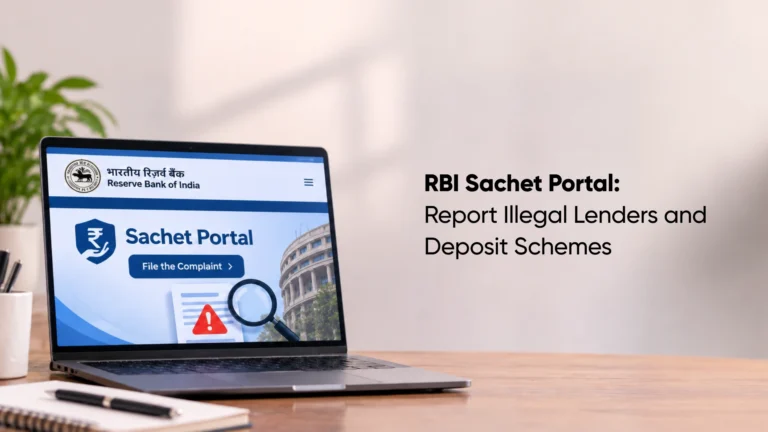
The RBI’s Sachet portal is the official place to report such activities. You can file a complaint at sachet.rbi.org.in.
In this guide, we explain what the Sachet portal is, which complaints you can file there, how to file and track a complaint step by step, and how to spot an illegal lender or deposit scheme.
Key takeaways
- The RBI Sachet portal allows you to file complaints against unregistered lenders and entities that collect deposits without authorisation. This includes Ponzi and multi-level marketing schemes.
- If you are filing a complaint against a bank or a registered NBFC, go to the lender’s grievance officer first, then the RBI’s Complaint Management System.
- After you file a complaint on the Sachet portal, it is forwarded to the regulator or law enforcement agency that can act on it.
- If you have lost money through a financial fraud, report it immediately by calling 1930 or on cybercrime.gov.in first, and then file on the Sachet portal.
What is the RBI Sachet portal?
The RBI Sachet portal is an online platform where you can report and track complaints against unregulated and unauthorised financial activity. According to the description on the Sachet portal, it manages complaints about unauthorised deposit collection and fraudulent schemes like Ponzi and multi-level marketing schemes, and it is available in thirteen languages.
The Reserve Bank of India hosts the portal, but it operates as an initiative of the State Level Coordination Committees. These committees unite financial regulators (RBI, SEBI, IRDAI and PFRDA) with state governments and enforcement agencies. This matters because an illegal scheme often falls under several authorities at once, and Sachet routes your complaint to the right one.
India also has a specific law against these schemes. The Banning of Unregulated Deposit Schemes Act, 2019 bans deposit schemes that are not regulated. You can find it in the list of Acts on the RBI website.
What complaints can you file on the Sachet portal?
The Sachet portal is meant for reporting suspected unauthorised financial activity. Some problems belong elsewhere, so it helps to know which forum handles what before you file.
The table below matches common problems with the right place to file them.
| Your problem | Where to file | Why |
|---|---|---|
| A company or person took deposits promising high returns and has stopped making payments | RBI Sachet portal | Unauthorised collection of deposits is exactly what Sachet handles |
| A chit fund, Ponzi or multi-level marketing scheme you suspect is illegal | RBI Sachet portal | Sachet routes it to the regulator or state agency responsible |
| A loan app that lends without naming any bank or NBFC | Sachet portal, and the cybercrime portal | The RBI asks the public to report unauthorised lending apps and their bank accounts to law enforcement or on RBI Sachet portal |
| Threats, abusive recovery calls or morphed photos from a loan app | 1930 helpline or cybercrime.gov.in | Harassment and online fraud need law enforcement, and speed matters |
| A complaint against your bank or a registered NBFC | The lender’s grievance officer, then the RBI’s Complaint Management System | Regulated entities are handled under the RBI’s Complaint Management System |
| You know of a suspect scheme but have not lost money | “Help your Regulator” on Sachet | You can share information, and attach documents or photos, so regulators can look into it |
In its caution against unauthorised digital lending platforms and mobile apps, the RBI says legitimate public lending can be done by banks, RBI-registered NBFCs and lenders regulated by state money-lending laws. Check that a lending platform is one of these, or names the one behind it, before using its services.
How to file a complaint on the Sachet portal
You can file a complaint on the RBI Sachet portal in five steps. Before you start, keep these details handy: the name of the entity, its address or website, the amounts you paid with dates, and any receipts, messages or screenshots.
- Visit the official website. Go to sachet.rbi.org.in and select “File a Complaint” on the home page.
- Choose your concern. Choose the option that best describes the activity you want to report. Each card directs you to the right regulator; some take you to that regulator’s own complaint portal, and the rest open Sachet’s complaint form. If you cannot find a suitable category, describe your concern in your own words, and the State Level Coordination Committee will try to forward it to the most suitable regulator.
- Enter the required details. Add the entity’s details, the amount involved, and any documents or information that can help.
- Add your mobile number. The portal uses it to send your complaint reference number and updates about its status.
- Submit and keep the complaint number. You can follow the progress with “Track Complaint” on the home page, using your mobile number or complaint ID.
A useful tip: choose the correct complaint category wherever possible. According to the Sachet help page, this leads to a faster resolution.
What happens after you file a complaint on the Sachet portal?
Your complaint is forwarded straight to the concerned regulator or law enforcement agency, which examines it and decides what action to take. Sachet itself does not investigate your complaint. Its job is to route it to the authority that can act on it.
While there is no definite timeline for resolution, you can track the status of your complaint on the portal.
How to spot an illegal lender or deposit scheme
Watch for these red flags before you hand over money or take a loan:
- Returns that sound too good. A scheme promising returns far above bank deposit rates is a warning in itself.
- Pressure to bring new members. Some fraudulent investment schemes encourage participants to bring in more people in exchange for commissions or higher returns. If the earnings depend largely on recruiting new members rather than a genuine business activity, it could be a warning sign.
- Not registered with a regulator. Before investing or borrowing, check whether the entity is authorised to carry out the financial activity it is offering. For a loan app, check that it clearly discloses the bank or NBFC. Our guide to RBI approved loan apps explains how to look it up.
- Payments requested in personal accounts. If you are asked to pay into, or receive money from, an individual’s bank account or UPI ID rather than the company’s, it is a red flag.
- Requests for your KYC documents from unknown people. The RBI warns never to share copies of KYC documents with unidentified persons or unverified apps.
For loan apps in particular, our guide to the signs of a fake loan app covers the warning signs in more detail, and our explainer on RBI rules on loan recovery sets out what a regulated lender may and may not do if you miss a payment.
Why is it important to borrow from a regulated lender?
When you are taking a loan, the simplest way to avoid any fraudulent activity is to borrow from a bank, an RBI-registered NBFC or a platform that clearly mentions the regulated lender behind it.
A regulated lender also gives you a Key Fact Statement (KFS) with the interest rate, processing fees and repayment schedule before you take the loan.
At Zype, personal loans are disbursed through RBI-registered NBFCs. You receive a Key Fact Statement with the applicable loan terms before accepting the offer.
You can explore Zype’s personal loan offering to understand the available loan amount, eligibility criteria and terms.
Frequently Asked Questions
What is the RBI Sachet portal?
It is an online platform, hosted by the RBI and run by the State Level Coordination Committees. You can file and track complaints about entities that collect deposits or money without authorisation, such as Ponzi and multi-level marketing schemes. Each complaint is forwarded to the regulator or agency that can act on it.
How can I file a complaint on the RBI Sachet portal?
Go to sachet.rbi.org.in, select “File a Complaint”, choose the option that matches your concern, fill in the form with the entity’s details and your documents, and add your mobile number. You receive a complaint number, which you can use with “Track Complaint” on the home page.
Can I report a fake loan app on Sachet?
Yes. The RBI has asked the public to report unauthorised lending apps, and the bank accounts linked to them, to law enforcement agencies or on the Sachet portal. If the app is threatening you, you can also call 1930 or file a complaint on cybercrime.gov.in.
Can I complain about my bank or NBFC on Sachet?
Complaints against a bank or a registered NBFC should go to the lender’s grievance officer first and then to the RBI’s Complaint Management System at cms.rbi.org.in. Sachet is meant for entities that are not regulated or are acting without authorisation.
How long does a Sachet complaint take?
There is no fixed timeline. The portal says regulators and law enforcement agencies give complaints immediate attention, but the resolution depends on factors such as legal procedures.
Is the RBI Sachet portal the same as the NDMA SACHET app?
No. The RBI’s Sachet portal at sachet.rbi.org.in handles complaints about illegal deposit schemes and unregulated financial activity. The NDMA’s SACHET is a separate platform for disaster and weather alerts.