It is common to assume the TDS on salary as a fixed percentage that everyone pays each month. However, your employer estimates your taxable salary for the full year, calculates the tax payable under your chosen tax regime, and then deducts that tax across the salary months left in the year.
That is why two people earning the same monthly salary can have different TDS deductions. Their tax regime, deductions, bonus, previous salary, other income or declarations may be different.
This guide explains how TDS on salary is calculated under the Income-tax Act, 2025, where it appears on your payslip, why the amount can change during the year, and how to verify that the tax deducted has been reported in your name.
Key Takeaways
- TDS on salary is based on your yearly taxable income, not a fixed monthly percentage.
- From 1 April 2026, salary TDS is covered under Section 392 of the Income-tax Act, 2025.
- Your TDS can change after a bonus, increment, job change or updated declarations.
- Check your payslip, Form 168 and Form 130 to make sure the TDS has been reported correctly.
What TDS on salary means
TDS stands for tax deducted at source. Instead of you paying all your income tax in one go after the year ends, your employer keeps back part of each month’s pay and deposits it with the government against your PAN (permanent account number). When you file your return, that deposited amount counts as tax you have already paid, so the TDS deduction on salary is really an advance on your final tax bill rather than an extra charge.
Your employer estimates your taxable salary for the full year and calculates the tax payable on it. The tax is then adjusted across the salary payments remaining in that year. This is why the TDS deducted from your payslip is not simply one tax slab percentage applied to your monthly salary.
What changed from April 2026
From 1 April 2026, salary TDS is governed by the Income-tax Act, 2025. Salary paid from that date is covered by Section 392, which replaces Section 192 of the Income-tax Act, 1961 for this purpose.
The new law also uses “tax year” instead of the older previous-year and assessment-year terminology. For example, salary from April 2026 to March 2027 falls in tax year 2026-27. The payment date decides which law applies, so any salary paid on or after 1 April 2026 falls under the new Act, as the Income Tax Department’s FAQs on the transition to the new Act explain.
Most of the forms you deal with as an employee also have new numbers under the Income-tax Rules, 2026:
| What it does | Old name | New name (from tax year 2026-27) |
|---|---|---|
| Rule that makes your employer deduct TDS on salary | Section 192 | Section 392 |
| Yearly TDS certificate your employer gives you | Form 16 | Form 130 |
| Quarterly TDS statement your employer files | Form 24Q | Form 138 |
| Your declaration of rent, investments and other claims | Form 12BB | Form 124 |
| Salary details from a previous employer in the same year | Form 12B | Form 122 |
| Your yearly tax statement on the income tax portal | Form 26AS | Form 168 |
The names and form numbers have changed, but their basic purpose remains the same. For example, Form 130 now serves as the annual TDS certificate for salary, replacing the earlier Form 16.
Is there a salary limit for TDS?
There is no fixed salary amount at which TDS automatically starts being applicable to everyone. Your employer deducts tax only when your estimated income for the year is high enough to leave some tax payable. Under the new regime, a resident can have up to ₹12 lakh of taxable income with no tax because of a rebate of up to ₹60,000. Add the ₹75,000 standard deduction for salary, and a pay of up to ₹12.75 lakh a year usually leads to no TDS at all. In practice, that makes ₹12.75 lakh a year the effective TDS on salary limit under the new regime when salary is your only income.
The table shows what that means for some common salaries. It assumes the new regime, salary as your only income, and no other deductions.
| Monthly gross salary | Yearly salary | Taxable income after ₹75,000 standard deduction | Yearly tax with 4% cess | TDS each month |
|---|---|---|---|---|
| ₹25,000 | ₹3,00,000 | ₹2,25,000 | Nil | Nil |
| ₹50,000 | ₹6,00,000 | ₹5,25,000 | Nil (rebate) | Nil |
| ₹60,000 | ₹7,20,000 | ₹6,45,000 | Nil (rebate) | Nil |
| ₹1,00,000 | ₹12,00,000 | ₹11,25,000 | Nil (rebate) | Nil |
| ₹1,08,000 | ₹12,96,000 | ₹12,21,000 | ₹21,840 (marginal relief) | ₹1,820 |
| ₹1,50,000 | ₹18,00,000 | ₹17,25,000 | ₹1,50,800 | ₹12,567 |
In these examples, salaries of up to ₹1 lakh a month result in no TDS under the new regime because salary is the only income assumed and the rebate removes the final tax liability. If you have other taxable income, such as interest, rent or income from another employer, the result can be different.
How to Calculate TDS on Salary: the six steps payroll follows
Payroll generally follows the same broad steps to calculate TDS on salary. Knowing them makes it easier to check whether the deduction on your payslip looks reasonable.
- Estimate your gross salary for the year. Basic pay, allowances, any bonus already known and the value of perquisites (benefits like a company car or rent-free housing) are added up for April to March.
- Take out what is exempt. Under the old regime this includes the exempt part of house rent allowance (HRA) and leave travel allowance. Under the new regime most of these exemptions are not available.
- Subtract the standard deduction. It is ₹75,000 under the new regime and ₹50,000 under the old regime.
- Subtract deductions you have declared. Under the old regime these include the ₹1.5 lakh investment deduction, health insurance and home loan interest. Under the new regime, the main one left for most employees is the employer’s contribution to your National Pension System (NPS) account.
- Work out the tax. Your employer applies the slab rates, then the rebate or marginal relief if you qualify, and then adds 4% health and education cess.
- Spread it over the pay months left. The yearly tax, minus TDS already deducted this year, is divided by the number of salary months remaining. In April that is 12 months, so the monthly TDS is about one twelfth of the yearly tax.
Income Tax Slabs Used for Salary TDS in Tax Year 2026-27
The new regime slabs for tax year 2026-27 are the same as the year before. The memorandum to the Finance Bill, 2026 confirms that no change is proposed in the tax rates:
| Taxable income | New regime rate | Old regime rate (below 60 years) |
|---|---|---|
| Up to ₹2.5 lakh | Nil | Nil |
| ₹2.5 lakh to ₹4 lakh | Nil | 5% |
| ₹4 lakh to ₹5 lakh | 5% | 5% |
| ₹5 lakh to ₹8 lakh | 5% | 20% |
| ₹8 lakh to ₹10 lakh | 10% | 20% |
| ₹10 lakh to ₹12 lakh | 10% | 30% |
| ₹12 lakh to ₹16 lakh | 15% | 30% |
| ₹16 lakh to ₹20 lakh | 20% | 30% |
| ₹20 lakh to ₹24 lakh | 25% | 30% |
| Above ₹24 lakh | 30% | 30% |
| Rebate | Up to ₹60,000 if taxable income is up to ₹12 lakh | Up to ₹12,500 if taxable income is up to ₹5 lakh |
The two columns rarely give the same answer for the same pay, which is why the regime you pick changes your TDS so much. Surcharge applies only when income crosses ₹50 lakh, so it is left out of the examples here.
Worked example: ₹1.5 lakh a month under the new regime
Say your gross salary is ₹1,50,000 a month, you have no other income, and you stay in the new regime. This is how to calculate TDS on salary for that case, line by line, so you can repeat it with your own figures.
| Step | Working | Amount |
|---|---|---|
| Gross salary for the year | ₹1,50,000 × 12 | ₹18,00,000 |
| Less standard deduction | ₹75,000 | |
| Taxable income | ₹17,25,000 | |
| Tax on ₹4 lakh to ₹8 lakh | 5% of ₹4,00,000 | ₹20,000 |
| Tax on ₹8 lakh to ₹12 lakh | 10% of ₹4,00,000 | ₹40,000 |
| Tax on ₹12 lakh to ₹16 lakh | 15% of ₹4,00,000 | ₹60,000 |
| Tax on ₹16 lakh to ₹17.25 lakh | 20% of ₹1,25,000 | ₹25,000 |
| Tax before cess | ₹1,45,000 | |
| Add 4% cess | ₹5,800 | |
| Tax for the year | ₹1,50,800 | |
| TDS each month | ₹1,50,800 ÷ 12 | ₹12,567 (rounded) |
Even though the highest slab applied in this example is 20%, that does not mean 20% of the full salary is deducted as TDS. There is no single TDS percentage on salary: tax is calculated progressively across the relevant slabs, so the effective TDS rate on salary here is about 8.4% (₹1,50,800 on ₹18 lakh).
The same salary under the old regime
Now take the same ₹18 lakh salary in Mumbai under the old regime. Assume basic pay of ₹75,000 a month, HRA of ₹30,000 a month, rent of ₹30,000 a month, ₹1.5 lakh of investments, ₹25,000 of health insurance and ₹2,500 of professional tax for the year.
The exempt HRA is the lowest of three figures: the HRA you receive (₹3.6 lakh), rent minus 10% of basic (₹2.7 lakh), and 50% of basic in a metro (₹4.5 lakh). That gives ₹2.7 lakh. After HRA, the ₹50,000 standard deduction, professional tax and the two deductions, taxable income comes to ₹13,02,500. Tax on that is ₹2,03,250, or ₹2,11,380 with cess, which is about ₹17,615 a month.
So in this case the new regime leaves you about ₹5,000 more in hand each month, even after giving up HRA and investment claims. Your own numbers may differ, especially with a large home loan, so compare both before you tell your employer. Our guide to the old vs new tax regime for 2026 walks through that choice by salary level.
How Marginal Relief Affects TDS Just Above ₹12 Lakh
Without a safety net, earning one rupee over ₹12 lakh of taxable income would cost you the full ₹60,000 rebate. Marginal relief prevents that. Under the new regime, if your taxable income is a little over ₹12 lakh, your tax before cess cannot be more than the amount by which you crossed ₹12 lakh.
Take a monthly salary of ₹1,08,000. Taxable income is ₹12,21,000, and the slab tax on it would be ₹63,150. Because you are only ₹21,000 over the line, the tax is capped at ₹21,000. With cess that is ₹21,840 for the year, or ₹1,820 a month. The relief fades out at roughly ₹12.7 lakh of taxable income, after which normal slab tax applies.
Once payroll has calculated your annual tax, the next step is to see how that amount actually appears in your monthly salary.
Where TDS shows up on your payslip
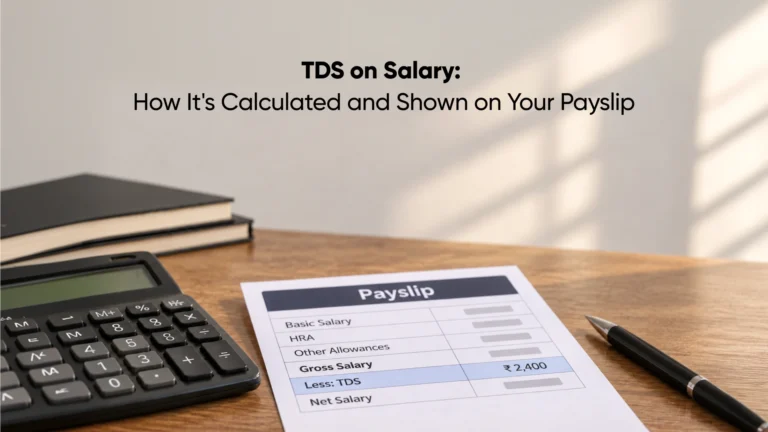
TDS in your salary slip usually appears in the deductions column, labelled “Income Tax”, “TDS” or “IT”. It sits alongside your provident fund contribution and professional tax, and it is subtracted from gross pay to give your net, or in-hand, salary. Here is how the September payslip for the ₹1.5 lakh example might look:
| Earnings | This month | Deductions | This month | Year to date (April to September) |
|---|---|---|---|---|
| Basic pay | ₹75,000 | Employee provident fund | ₹1,800 | ₹10,800 |
| House rent allowance | ₹30,000 | Professional tax | ₹200 | ₹1,200 |
| Special allowance | ₹45,000 | Income tax (TDS) | ₹12,567 | ₹75,400 |
| Gross earnings | ₹1,50,000 | Total deductions | ₹14,567 | |
| Net pay credited to your bank | ₹1,35,433 | |||
Two figures on this slip matter most for TDS. First, the “this month” figure is what left your pay today. Second, the year-to-date figure shows how much TDS your employer has deducted so far. After the employer files the relevant TDS statements and they are processed, this amount should eventually reconcile with the TDS information reported in Form 168, the Annual Information Statement under the new rules.
Many payslips also carry a small tax worksheet at the bottom showing projected yearly income, declared deductions and the regime used. If that worksheet shows the wrong regime or misses a declaration, your TDS will be off for every month that follows. The provident fund figure here assumes contribution on the statutory wage ceiling of ₹15,000; many employers contribute 12% of full basic instead.
If your payslip uses abbreviations you do not recognise, our explainer on the components of a salary slip covers each one.
Why the TDS on your payslip changes from month to month
Because TDS is the remaining yearly tax divided by the remaining months, any change in your yearly estimate shows up straight away in the months left. That is normal, and the table lists the usual triggers along with what you can do about each one.
| What happened | What it does to TDS | What you can do |
|---|---|---|
| You got an increment or arrears mid-year | TDS rises for the rest of the year, sometimes sharply | Check the new projected income on your payslip worksheet |
| A bonus or incentive was paid | TDS jumps in that month, or rises for the months left | Expect a smaller net credit that month |
| You submitted proofs in January or February (old regime) | TDS can rise if proofs were short of what you declared in April | Submit proofs on time and match them to your declaration |
| You declared rent or investments late | TDS falls for the months left, since the full benefit is squeezed into fewer months | Submit Form 124 early in the year |
| You joined from another employer mid-year | TDS may be too low if the new employer does not know your earlier pay | Give your new employer Form 122 with the earlier salary and TDS |
| You switched regime with your employer | TDS is recalculated from that month | Confirm the regime on the next payslip |
Here is the increment case in numbers. Suppose the ₹1.5 lakh employee gets a raise to ₹1,65,000 a month from October. From April to September, ₹75,400 was deducted. The new yearly estimate is ₹18.9 lakh, so the yearly tax becomes ₹1,69,520. That leaves ₹94,120 to recover in six months, so TDS rises from ₹12,567 to about ₹15,687 a month. Your raise is ₹15,000, yet in-hand pay goes up by only about ₹11,880, because the full year’s extra tax is caught up in the second half.
If Your TDS Looks Wrong, What Should You Check?
If the TDS on your payslip suddenly looks too high or too low, check the inputs payroll is using before assuming the calculation is wrong.
- Tax regime: Is payroll using the regime you selected?
- Projected salary: Has an increment, bonus or arrears payment changed your expected annual income?
- Declarations: Have your eligible claims and supporting proofs been considered?
- Previous employer: If you changed jobs, has your earlier salary and TDS been included?
- Other income: Have you declared taxable income that payroll needs to consider?
- PAN details: Is your PAN correctly recorded?
If the figures still do not make sense, ask payroll for the annual tax computation used to arrive at your monthly TDS.
How to Check That Your TDS Reached the Government
Seeing TDS on your payslip confirms that your employer deducted it from your salary. You should also check that the deduction has been correctly reported against your PAN.
| Check | What it tells you |
|---|---|
| Payslip | TDS deducted from your salary this month and year to date |
| Form 168 | TDS and other tax information reported against your PAN |
| Form 130 | Employer’s annual salary-TDS certificate and tax computation |
| Income tax return | Your final tax liability after giving credit for TDS already reported |
A deduction on your payslip is only half the job. Your employer must also deposit the money and report it against your PAN, or you will not get credit for it. Employers usually deposit TDS by the 7th of the following month (30 April for tax deducted in March) and report it every quarter in Form 138.
You can check it yourself in three places:
- Your payslip: note the year-to-date TDS figure at the end of each quarter (June, September, December and March).
- Form 168: This is the Annual Information Statement under the Income-tax Rules, 2026 and replaces the earlier Form 26AS. Check whether the salary TDS reported by your employer appears against your PAN. Our guide to downloading Form 26AS shows where to find it on the portal.
- Form 130: Your employer issues this annual TDS certificate after the tax year. It replaces the earlier Form 16 and summarises salary paid, tax deducted and deposited, and the tax computation used for the year. The Income Tax Department’s Form 130 FAQs list what each part contains.
What If TDS Is Deducted but Not Showing in Your Tax Records?
If TDS appears on your payslip but is still missing from Form 168 after the relevant filing has been processed, raise it with your employer or payroll team. The issue may be due to a reporting delay, incorrect PAN details or an error in the employer’s TDS statement.
Your employer may need to correct or update the filing before the TDS appears correctly against your PAN.
When too much or too little TDS is deducted
Your employer calculates TDS based on the income details available during the year. The final tax is confirmed only when you file your income tax return.
If too much TDS is deducted, you can claim the extra amount as a refund while filing your return. This can happen if your employer did not consider an eligible deduction in time or if your income changed during the year. Our guide to filing your first income tax return walks through the steps.
If too little TDS is deducted, you may need to pay the remaining tax before filing your return. This can happen when you have other taxable income, such as interest or rent, that your employer did not know about. Sharing these details with payroll during the year can help reduce a large tax shortfall later.
Two other points to remember:
- PAN details: If your employer does not have a valid PAN for you, a higher TDS rate may apply. Check with payroll or a tax professional if this applies to you.
- Tax regime: If you do not choose a regime with your employer, the new regime is generally used for TDS. Eligible salaried taxpayers may still choose the old regime when filing their return, subject to the applicable rules.
Why your take-home pay matters when you borrow
Your take-home salary is the amount left after deductions such as TDS, provident fund and professional tax. This is the money you actually have available for rent, bills, existing EMIs and any new repayment.
For example, if your gross salary is ₹1.5 lakh but about ₹1.35 lakh reaches your bank account, your EMI should be planned around the amount you actually receive, not your gross salary.
This is why it helps to check your in-hand salary before taking a new loan. A manageable EMI should leave enough room for your regular monthly expenses and existing commitments.
If you are exploring a personal loan, our page on loans by salary shows what different salary levels can support, and Zype’s personal loans for salaried employees page sets out the eligibility and repayment options. Loans on Zype are disbursed via RBI-registered NBFCs.
Frequently Asked Questions
How much TDS is deducted on salary each month?
It depends on your yearly taxable income, tax regime, deductions and other income. In the example above, a ₹1.5 lakh monthly salary with no other income results in TDS of about ₹12,567 a month under the new regime.
Is TDS deducted on a salary of ₹50,000 a month?
Usually not under the new regime if salary is your only income. A ₹50,000 monthly salary is ₹6 lakh a year, and after the ₹75,000 standard deduction, the taxable amount remains within the ₹12 lakh rebate limit. TDS may still differ if you have other taxable income or choose the old regime.
Under which section is TDS on salary deducted now?
For salary paid from 1 April 2026, TDS on salary is governed by Section 392 of the Income-tax Act, 2025. Salary paid up to 31 March 2026 was governed by Section 192 of the Income-tax Act, 1961.
Will I still get Form 16?
For salary paid up to 31 March 2026, you still get Form 16 under the old Act. For salary covered by the Income-tax Act, 2025, the annual salary-TDS certificate is Form 130, which replaces Form 16. For tax year 2026-27, it is issued after the year ends and serves the same broad purpose of showing salary and TDS details. Our guide to Form 16, 16A and 16B explains the older certificates.
How do I get a TDS refund on salary?
File your income tax return and claim the TDS reflected in your tax records. If the final tax payable is lower than the TDS already credited, the excess may be refunded after your return is processed.
Can I ask my employer not to deduct TDS?
Not if tax is payable on your estimated salary for the year. Your employer is required to deduct TDS based on the applicable tax rules.
You can, however, make sure the calculation is accurate by choosing the appropriate tax regime and submitting eligible declarations or claims on time. If your estimated taxable income does not result in any tax payable, TDS should generally not be deducted.
What if I worked for two employers in the same year?
When you change jobs during the same tax year, the new employer needs details of salary and TDS from the previous employer so that tax can be calculated on your combined annual salary. Give your new employer Form 122 with your earlier salary and TDS, so the rest of the year’s TDS covers your full income. Each employer issues its own Form 130 for the period you worked there.