
Key Takeaways
- You can easily buy an iPhone on EMI. A personal loan, debit card EMI, BNPL, or cardless financing are some options you can explore.
- Each one can help spread the cost, but the best option is the one with an affordable EMI, a comfortable repayment plan, clear charges, and the lowest total cost.
- A personal loan from Zype will help you cover the cost of an iPhone in flexible instalments. Interest rates starts at 18 % p.a.
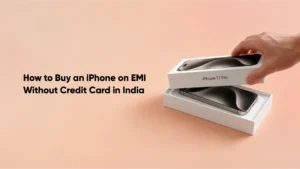
Yes, you can buy an iPhone on EMI without a credit card in India. Options such as a personal loan, debit card EMI, BNPL and cardless consumer finance allow eligible buyers to spread the cost into monthly payments. Each option comes with different eligibility rules, interest rates, fees and repayment terms. Compare the total amount payable, not just the monthly EMI, before choosing a plan.
This blog explores each option to help you decide the best option as per your financing needs.
Table of Contents
ToggleCan You Buy an iPhone on EMI Without a Credit Card?
Yes, you can buy an iPhone on EMI in India without a credit card. Options like a personal loan, debit card EMI, BNPL services, and in-store consumer finance options let you split the cost into monthly instalments, each with different eligibility rules and total costs.
| Option | How It Works | Best For |
|---|---|---|
| Personal Loan | Loan amount credited to your bank account; use it to pay any retailer | Flexibility to buy from any store |
| Debit Card EMI | Pre-approved facility by your bank; repaid via linked account | Existing bank customers with eligible debit cards |
| BNPL | Short-term credit on select platforms; spend limit applies | Smaller purchases on supported apps |
| Consumer Finance | In-store or checkout financing by an NBFC partner | In-store purchases at participating retailers |
Ways to Buy an iPhone on EMI Without Credit Card
You can finance an iPhone without a credit card through a personal loan, eligible debit card EMI, BNPL or cardless consumer finance. The right option depends on your eligibility, preferred retailer, available credit limit and total repayment cost.
| EMI option | How it works | Where you can buy | What to check | Best suited for |
|---|---|---|---|---|
| Personal loan | The approved amount is credited to your bank account. You can use it to purchase the iPhone and repay the loan through fixed monthly EMIs. | Any online or offline retailer that accepts regular payments | Interest rate, APR, processing fee, tenure, total repayment and prepayment terms | Buyers who want to choose their retailer and are not eligible for checkout-based EMI |
| Debit card EMI | Eligible customers can convert the purchase into EMIs through a pre-approved facility offered by their bank. The EMI is deducted from the linked bank account each month. | Retailers and checkout platforms that support the customer’s bank | Pre-approved limit, supported merchants, interest rate, processing fee and available tenure | Existing bank customers with an eligible debit card EMI offer |
| Buy Now, Pay Later | A BNPL provider pays the merchant, and the customer repays the amount over a short tenure. Approval and spending limits depend on the provider. | Selected partner merchants and online platforms | Whether the available limit covers the iPhone price, along with interest, late fees and repayment period | Buyers who already have a sufficient BNPL limit and need a short repayment tenure |
| Consumer finance or cardless EMI | The customer applies for financing at the store or during online checkout. After KYC and approval, the lender pays the retailer and the customer repays in EMIs. | Participating electronics stores, authorised resellers and selected e-commerce platforms | Down payment, retailer eligibility, interest, processing fee, tenure and whether the offer is genuinely no-cost EMI | Buyers purchasing from a retailer that offers an eligible point-of-sale finance option |
Suppose the iPhone you want costs ₹1 lakh. The way you pay for it will depend on your available credit limit, bank eligibility, the retailer’s financing options, and whether you can make a down payment.
Some options may cover the full cost, while others may require you to pay part of the amount upfront. Here is how each option may work:
| Option | How the ₹1,00,000 Purchase May Work | What to Check |
|---|---|---|
| Personal Loan | You can borrow the required amount and pay the retailer directly from your bank account. | Interest rate, processing fee, EMI and total repayment shown in the KFS. |
| Debit Card EMI | The purchase may be converted into EMIs if your bank and debit card are eligible. | Pre-approved limit, supported retailer and whether any amount is blocked in your account. |
| BNPL | You may pay in instalments, but the available limit may not cover the complete ₹1,00,000. | Credit limit, repayment period, interest and late-payment charges. |
| Consumer Finance | A retailer’s finance partner may fund the purchase and collect the amount through monthly EMIs. | Down payment, store eligibility, processing charges and available tenure. |
For example, if your BNPL limit is ₹40,000, you may need to pay the remaining ₹60,000 separately. A personal loan may offer more flexibility because the money is credited to your bank account, allowing you to purchase the iPhone from a retailer of your choice
How to Buy an iPhone on EMI with Zype Personal Loan
If you want to buy your iPhone from any store of your choice without being tied to a specific lender’s, a personal loan through Zype gives you that freedom.
With Zype, salaried users can apply for a personal loan of up to Rs. 5,00,000 through a fully digital in-app journey. The application takes about 5 minutes. Once approved, the loan amount is credited to your bank account, and you can use it to pay any retailer of your choice.
Before accepting, review the Key Fact Statement (KFS), which shows your EMI amount, interest rate, processing fee, and total repayable amount upfront. No surprises after signing.
Eligibility Criteria to Buy an iPhone on EMI Without Credit Card
To buy an iPhone using a Zype personal loan, you need to meet Zype’s basic eligibility requirements. Final approval is based on factors such as your age, employment stability, monthly income, credit profile, and ability to repay the loan comfortably.
| Eligibility Factor | Requirement |
|---|---|
| Employment type | Salaried |
| Age | 18 to 58 years |
| Minimum monthly salary | Rs. 15,000 (approximate benchmark) |
| Credit score | 600 and above may improve eligibility |
| Residency | Indian resident |
Note: Loan approval depends on your credit profile and eligibility. Meeting the above criteria does not guarantee approval.
Documents Required for iPhone EMI Without Credit Card
Zype verifies all the documents digitally. No need for any physical documents. You’ll typically need these for verification:
- PAN card
- Aadhaar card
- Selfie or liveness check
- Bank statement (may be requested for higher loan amounts)
Interest Rate, Fees and Repayment Terms
The cost of your Zype personal loan will depend on the offer you receive. Review the Key Fact Statement (KFS) that includes the interest rate, fees and repayment terms carefully before accepting it.
| Detail | Zype Personal Loan |
|---|---|
| Loan amount | Up to Rs. 5,00,000 |
| Interest rate | 18% to 34% p.a. |
| Processing fee | 2% to 6% of loan amount (+ GST) |
| Tenure options | 6, 9, 12, and 18 months |
| Foreclosure charges | Zero charges on Zype |
| KYC | Digital process completed with vKYC |
Illustrative EMI for an iPhone Purchase: Suppose you take a ₹75,000 Zype personal loan to buy an iPhone. The table below shows the approximate EMI at an annual interest rate of 18%.
| Repayment tenure | Approx. monthly EMI | Approx. total interest | Approx. total repayment |
|---|---|---|---|
| 6 months | ₹13,164 | ₹3,986 | ₹78,986 |
| 9 months | ₹8,971 | ₹5,737 | ₹80,737 |
| 12 months | ₹6,876 | ₹7,512 | ₹82,512 |
| 18 months | ₹4,785 | ₹11,138 | ₹86,138 |
Note: The figures are illustrative and calculated at 18% p.a. The actual EMI will depend on the approved loan amount, interest rate and tenure. Processing fees and applicable GST are not included.
A longer tenure can reduce your monthly EMI, but it increases the total interest paid. Choose a tenure that keeps the EMI manageable without making the overall loan unnecessarily expensive.
Things to Compare Before Choosing EMI for iPhone
The monthly EMI is the first number most people look at. But it’s not the only number that matters. Here’s what to actually check before you commit:
- Total repayment amount, not just the monthly EMI: Two plans with similar monthly EMIs can have very different total costs depending on the tenure and interest rate. Always understand the total amount you’ll pay by the end of the loan. That’s the real cost.
- APR, processing fee & GST: The Annual Percentage Rate (APR) gives you a more complete picture of borrowing cost than the interest rate alone. Processing fees (typically 1–6% of the loan amount) and GST on those fees add to what you owe, so factor these in upfront.
- No-cost EMI vs low-cost EMI: “No-cost EMI” doesn’t always mean the interest is waived. In most cases, the retailer or brand absorbs it as a discount, so you end up paying the MRP in instalments, and may lose out on cashback or bank offers available on full payment. Always check what “no-cost” actually means for that specific offer.
- Down payment and retailer discounts: If you’re taking a personal loan, you pay the retailer directly and can still use available exchange offers or bank discounts to bring down the purchase price before applying.
- Repayment tenure: A longer tenure means smaller monthly EMIs, but you pay more interest overall. A shorter tenure saves money, but puts more pressure on your monthly budget. Pick a tenure where the EMI feels comfortable, not just manageable.
- Late payment charges and CIBIL impact: A missed or delayed EMI can attract penalty charges and hurt your credit score. Set up an auto-debit (NACH mandate) so payments go through automatically each month.
- Prepayment and foreclosure terms: If you want to repay early, check whether the lender charges a foreclosure fee. Zype doesn’t charge foreclosure fees. Some consumer finance and debit card EMI plans may have restrictions, so it’s worth checking in advance.
- Returns, refunds and loan closure: If you return or exchange your iPhone after taking a loan, the retailer’s refund goes back to the lender but your loan doesn’t automatically close. Clarify the return and refund process with both the retailer and the lender before you sign up.
How to Apply for iPhone EMI Without Credit Card
Personal Loan through Zype
- Apply on the Zype app: Sign up and enter your personal details.
- Complete digital KYC: Verify your PAN and Aadhaar and complete e-KYC.
- Review and accept the offer: Check the EMI, interest rate, fees and total repayment in the KFS before e-signing.
- Receive the funds: Once approved and all required steps are completed, the amount is disbursed instantly to your bank account. You can then buy the iPhone from your preferred retailer.
Debit card EMI
Let say you need to pay for an iPhone 14 Pro on EMI at a participating retailer if your bank has provided an eligible debit card EMI limit.
- Check your eligibility: Confirm through your bank’s app, website or customer service whether debit card EMI is available to you.
- Choose the iPhone: Select a participating online or offline retailer that supports your bank’s debit card EMI.
- Select the EMI plan: At checkout, choose Debit Card EMI and select an available tenure.
- Complete the purchase: Authenticate the payment. The EMI will be deducted automatically from your linked bank account each month.
In-store or cardless finance
Say you are looking to pay for a iPhone 14 Pro Max EMI purchase, you can check whether the retailer offers cardless consumer finance and compare the down payment, tenure and total repayment before proceeding.
- Visit a participating retailer: Choose a store that offers cardless EMI or consumer finance for the selected iPhone.
- Apply for financing: Provide the required KYC and income details to the financing provider.
- Review the terms: Check the down payment, tenure, EMI, interest, processing fee and total repayment.
- Complete the purchase: Sign the loan agreement and collect the iPhone. EMI payments usually begin from the repayment date mentioned in the agreement.
FAQs on Buying iPhone on EMI Without Credit Card
Is salary proof required to buy an iPhone on EMI?
It depends on the lender and EMI option. Pre-approved or card-based EMI may not require salary proof, while a mobile loan provider may request salary slips or bank statements to verify income.
Can first-time borrowers get iPhone EMI approval?
Yes, first-time borrowers may be approved if they meet the lender’s eligibility criteria. Moreover, loan approval depends on employment stability and repayment capacity.
What is the minimum salary required to buy an iPhone on EMI?
The minimum salary required to buy an iPhone on loan depends on the lender you choose, as each lender sets its own eligibility criteria. The required income may also vary based on the iPhone’s price, down payment, and selected tenure.
Can I prepay my mobile loan before the tenure ends?
Yes, you can prepay your mobile loan before the tenure ends. Some lenders, including Zype, do not charge a prepayment fee, while others may have a fee or lock-in period, so check the loan agreement or Key Facts Statement first.
Is Aadhaar mandatory for iPhone EMI approval?
Aadhaar is commonly used for quick digital KYC, but it is not universally mandatory for KYC. Other officially valid documents may be accepted depending on the lender and process.
How quickly can I get loan approval for an iPhone purchase?
Digital or pre-approved EMI applications may be approved within minutes, while applications requiring income or document verification can take longer. On Zype, get loan approval in minutes, on eligibility fulfilment.
Can I buy an iPhone on EMI with low or no credit history?
Yes, it may be possible, although approval depends on the lender’s eligibility criteria. At Zype, your application is assessed using multiple factors, including your monthly income, employment stability, and repayment capacity, rather than credit history alone.