Table of Contents
ToggleKey Takeaways
India mainly issues three passport categories: Ordinary (Blue), Official (White), and Diplomatic (Maroon)
Most people in India need only an Ordinary (Blue) Passport for personal travel like tourism, study, or private jobs.
Official (White) and Diplomatic (Maroon) passports are issued only for government or diplomatic duty, based on eligibility
An ePassport is not a new category like blue or white. It is a passport with a chip for added security.
Introduction
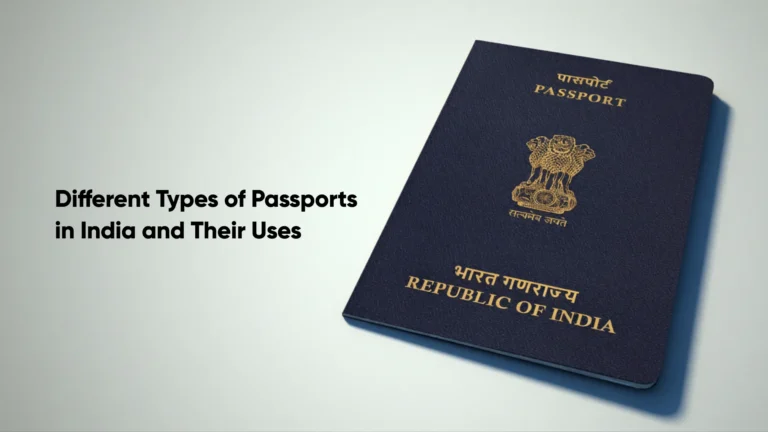
If you’ve ever travelled abroad, you’ve probably held that deep blue Indian passport in your hand and not thought much about it. But that little booklet is officially called a Type P passport, where “P” stands for Personal. It is issued to regular Indian citizens for leisure trips, work travel, study, or visiting family abroad.
Besides that, there are different types of passport in India, depending on who you are and why you’re travelling. In this blog, we’ll break down the main passport types in India, what each one is used for, who can get it, and how to know which category applies to you.
How Many Types of Passports Are Issued in India?
India mainly issues three core types of passport in India: Ordinary (Blue), Official (White), and Diplomatic (Maroon) [1]. In addition, there are special travel documents like the Emergency Certificate and Identity Certificate for specific cases.
| Document / Passport Type | Colour | Issued To | Typical Validity | What It’s Used For |
|---|---|---|---|---|
| Ordinary Passport | Blue | Indian citizens | Usually 10 years (adults), 5 years (minors) | Tourism, study, private job, business travel |
| Official Passport | White | Government officials on official duty | Often tied to assignment | Official government visits abroad |
| Diplomatic Passport | Maroon | Diplomats and authorised officials | As per duty norms | Diplomatic travel |
| Emergency Certificate (EC) | Not a regular passport | Indian nationals abroad in urgent cases | Usually single journey | Most often for urgent return to India |
| Identity Certificate (IC) | Not a regular passport | Specific eligible categories (example: Tibetan refugees residing in India) | Case-based | Travel when a regular national passport is not available |
| Short-validity passport (SVP) | Blue (ordinary category) | Special cases | Short duration | Limited travel with conditions |
What is a Passport and Why is it Important?
A passport is a government-issued document that certifies your identity and nationality. It includes key details like your full name, photograph, signature, date of birth, nationality, passport number, and its issue and expiry dates.
Think of it as your main travel ID. Understanding the types of passport in India is important because it determines the eligibility rules that apply to you. It helps immigration officials verify who you are when you enter or leave a country, and it also allows you to access consular help from India if you need support abroad.
Purpose of a passport
A passport is your official travel identity when you cross international borders. It confirms:
- immigration checks at airports
- visa applications
- identification while you are abroad
It is also one of the most widely accepted ID documents globally, and it is usually required for visa applications and immigration checks.
When a passport is required
A passport is required whenever you cross an international border. Even if a country allows visa-free entry, you still need a valid passport to board flights and clear immigration.
You typically need a passport when you:
- travel outside India (tourism, work, study, business),
- apply for most visas,
- need an internationally accepted proof of identity while abroad.
Note: A passport is not a visa. A passport identifies you. A visa is permission from another country to enter.
Ordinary Passport (Blue Passport)
The Blue Passport is issued to Indian citizens travelling for personal reasons like tourism, education, business trips, or private employment abroad.
Who it is issued to
This is the standard passport issued to Indian citizens for personal travel. It is the most common passport type.
Common uses of an ordinary passport
You use a blue passport for:
- vacations and family travel
- higher studies abroad
- work trips and conferences
- visiting relatives overseas
Example: If you are going to Thailand for a holiday, or Canada for a course, or Dubai for a private job, you will use the same blue passport. Your visa rules depend on the country you are visiting, not the colour of this passport.
>> Planning a trip soon? Check personal loan for travel to see how EMIs and repayment work.
Official Passport (White Passport)
An official passport is meant for government-related travel. It tells immigration authorities that the person is travelling on official duty, not as a private citizen.
Who is eligible
A white passport is issued only when a person is travelling abroad as part of an official government assignment. It is not something you apply for as a general upgrade. Eligibility is linked to your role and the purpose of travel.
Purpose of an official passport
The main purpose is to support official government travel and make the travel context clear during immigration and processing.
Also, the validity of diplomatic and official passports is often specific and may be five years or less, depending on the assignment and position.
Example: An Indian government officer attending an official delegation meeting overseas may be issued a white passport for that assignment.
Diplomatic Passport (Maroon Passport)
A diplomatic passport is issued for diplomatic duty and representation. It is used by diplomats and certain authorised officials.
Who receives a diplomatic passport
Diplomatic passports are issued to Indian diplomats and certain high-ranking officials travelling on diplomatic duty. This is governed by official rules and approvals, not personal preference.
Special privileges and usage
A diplomatic passport can make certain parts of travel smoother, but it does not mean “no questions asked.” Entry rules still apply. Some countries also have specific visa exemptions or simplified processes for diplomatic or official passport holders, based on bilateral arrangements.
Example: If an official trip is covered under a visa-waiver agreement, the diplomat may not need a visa for short stays in that country (rules vary by country and agreement).
Emergency Certificate Passport
This is not a regular passport category like blue, white, or maroon. It is a temporary travel document used when a normal passport is not available in an emergency.
When an emergency certificate is issued
An Emergency Certificate (EC) can be issued to an Indian national when they do not have a usable passport due to loss, damage, or expiry, and a new passport cannot be issued immediately. It is often used to help the person travel back to India quickly and is typically issued by an Indian Embassy or Consulate.
Validity and limitations
An EC is typically a one-way travel document and is usually meant for a single journey, not regular international travel like a normal passport.
If you are abroad and this happens, you usually need to contact the nearest Indian Embassy or Consulate for the correct process.
Certificate of Identity Passport
An Identity Certificate is a travel document used in specific situations where a regular national passport is not available to the applicant.
Who can apply
A Certificate of Identity is issued to certain eligible categories who need a recognised travel document but may not hold a regular national passport. It is issued through defined government rules and verification.
As per Passport Seva’s official FAQ, the Certificate of Identity (Identity Certificate) is noted as being normally issued to Tibetan refugees residing in India, through the Regional Passport Office, Delhi. [1]
Situations where it is used
It is used when an eligible person needs an officially recognised travel document to travel internationally but does not have a regular passport. Because it is a special case document, requirements and approvals can be stricter than normal passport applications.
Note: People often confuse ePassport with passport type. An ePassport isn’t a separate category like a blue or white passport. It is the same passport category you are eligible for, just issued as a booklet with an embedded chip for stronger security and faster verification. [2]
Type of Passports Based on Validity
Aside from passports getting categorised by colour, there is another practical classification: validity. Most people get regular validity, but some cases get shorter validity.
Short-validity passport
A Short Validity Passport (SVP) is generally issued in specific special cases. Passport Seva’s FAQ notes SVP is issued in situations such as when a criminal case is pending and the applicant has court permission, among other cases.
Think of it as permission with a shorter timeline, not a different passport category.
Regular validity passport
For adults, passport validity is generally 10 years. For minors, it is generally five years
Before booking flights, check that your passport has enough remaining validity as required by your destination.
How to Choose the Right Passport Type
You can choose the right passport type once you know your purpose and travel role.
Purpose of travel
For most people, the choice is straightforward:
- travelling for personal reasons (tourism, study, private job): Ordinary (Blue) passport
- travelling as a government representative on duty: Official (White) passport
- travelling on diplomatic duty: Diplomatic (Maroon) passport
Duration and destination
Your destination matters because:
- some countries have strict rules about minimum passport validity
- visa rules vary by country and travel purpose
- some diplomatic or official holders may have visa waivers depending on agreements
ECR (Emigration Check Required): What You Should Know
ECR status mainly applies to people travelling abroad for employment in certain notified countries. If your passport has an ECR endorsement and you are going to one of these countries for work, you may need emigration clearance before departure.
If you are travelling for tourism, business, or visiting family, clearance is generally not required, even with ECR status. Always check your passport category and destination rules in advance to avoid last-minute issues at the airport.
Planning Travel Expenses Along With Your Passport
When travelling abroad, a passport is essential. Aside from that there are other aspects to travel that you need to consider.
Common travel costs beyond passport fees
Passport costs are only the starting point. People usually spend more on visa fees, documents, flight tickets, stay bookings, local transport, and forex. If it is your first international trip, keep a buffer for small surprises like baggage upgrades, airport transfers, and last-minute booking price jumps.
A simple tip: make an essential list (visa, tickets, initial stay) and a variable list (food, local travel). It makes budgeting easier.
Managing travel expenses with short-term loans
Sometimes travel costs hit at once: flight prices jump, a visa appointment opens suddenly, or you need to block hotel bookings quickly.
Need to book flights before prices jump or lock a visa slot quickly? Consider a travel loan or a personal loan on Zype and see what works for your budget.
If you are exploring a short-term personal loan option, keep it sensible:
- borrow only what you can comfortably repay,
- pick a tenure that matches your cash flow (for example, 6, 9, 12 or 18 months),
- check the total repayment and charges before accepting any offer (look for the Key
Fact Statement).
Zype offers complete ditial experience. Just download the Zype App to get instant personal loan. Check your eligibility, compare the total repayment, and choose a tenure that keeps your monthly EMI comfortable. Do everything in-app, see the total cost upfront in the Key Fact Statement (KFS). And once you accept the offer, the amount is credited to your bank account instantly.
Download the Zype App, check your eligibility, compare the total repayment, and choose a tenure that keeps your monthly EMI comfortable. Do everything in-app, see the total cost upfront in the Key Fact Statement (KFS). And once you accept the offer, the amount is credited to your bank account, instantly.
Sources:
[1] https://services1.passportindia.gov.in/psp/Faqs
[2] https://www.tataaig.com/knowledge-center/travel-insurance/types-of-passports-in-india
Frequently Asked Questions (FAQs)
How many types of passports are issued in India?
India’s main passport categories are Ordinary, Official, and Diplomatic. Other documents like Emergency Certificate and Identity Certificate are special travel documents used in specific cases.
What is the difference between blue and white passport?
A blue passport is for Indian citizens travelling for personal purpose while a white passport is issued to eligible government officials travelling on official duty.
Who is eligible for a diplomatic passport?
Diplomatic passports are issued to Indian diplomats and certain authorized officials travelling for diplomatic assignments, as per government rules and approvals.
Can I travel internationally with an emergency certificate?
An Emergency Certificate is typically a one-way emergency travel document, often used to return to India when a valid passport is not available due to loss, damage, or expiry
Does passport type affect visa approval?
Yes, passport type does affect visa approval. For regular travellers, visa approval depends on the country’s visa rules and your profile. For diplomatic or official passport holders, some countries have visa exemption or waiver agreements, so visa requirements may differ in those cases.