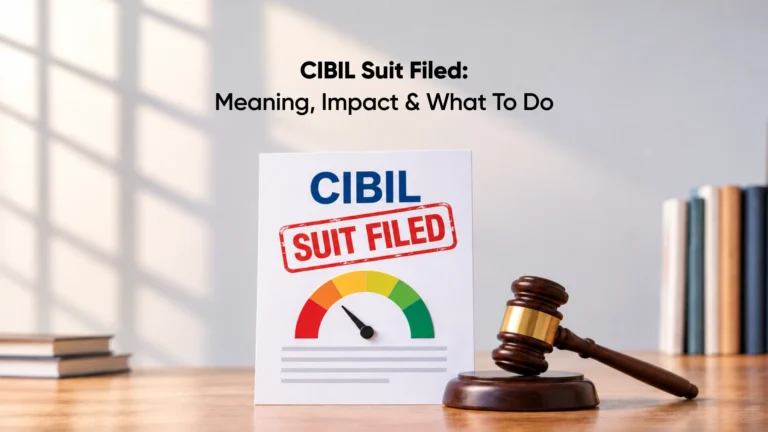
A suit filed status in your CIBIL report means a lender has started legal recovery action over unpaid dues and reported it to the credit bureau. It is a serious negative entry, but the next step depends on whether you still owe the money, have already paid, believe the entry is wrong, or have received a court summons.
Key Takeaways
- Suit filed means legal recovery action has been reported against a loan or credit account.
- It is different from written off, settled and wilful default.
- Check your full CIBIL report, not only the public suit-filed database.
- An accurate entry cannot simply be deleted; the underlying matter must first be resolved.
- If the entry is wrong, you can raise a dispute.
- If you receive a court summons, seek qualified legal advice.
Why a lender files a suit: the usual timeline
A suit usually follows a longer period of missed payments and recovery attempts. The exact timeline differs by lender, but the process often follows a similar pattern.
| Stage | What happens | Shows on your report? |
|---|---|---|
| First missed EMI | Reminder calls, SMS and late fees | Yes, as days past due (DPD) |
| 30 to 90 days late | More reminders; the account moves into overdue buckets | Yes, DPD rises each month |
| More than 90 days late | The lender classifies the loan as a non-performing asset (NPA) | Yes, often with an asset class such as “SUB” or “DBT” |
| Months later | Demand notice followed by a legal notice | DPD keeps building |
| No response or no agreement | The lender files a recovery suit | Yes, as “Suit filed” |
An equated monthly instalment (EMI) is the fixed amount you repay each month, and days past due (DPD) counts how late each EMI is. To read more about these terms in more detail, see our guide to days past due and the post on STD, LSS and DPD in CIBIL.
Suit filed vs wilful default vs written off vs settled
These four remarks are often mixed up, partly because they can appear together on the same account. Here is how they differ
| Status | What it means | Who decides | After you pay |
|---|---|---|---|
| Suit filed | The lender has started a court case to recover dues | The lender, by filing the case | The lender reports the case as closed once it ends |
| Wilful default | The borrower could repay but chose not to | The lender, through a formal review under RBI rules | Removal follows a separate process |
| Written off | The lender has moved the unpaid loan off its books as a loss | The lender, for its own accounts | It can change to “settled” or “closed” |
| Settled | You agreed with the lender to pay less than the full dues | You and the lender together | “Settled” stays; full payment can turn it into “closed” |
Wilful default is rare for small personal loans. Under RBI rules, a lender examines wilful default only in NPA accounts with ₹25 lakh or more outstanding, and it needs a formal review before anyone is named a wilful defaulter. For the other two remarks, read our guides on the written off status and on loan settlement.
How to check for a CIBIL suit filed entry
Your own CIBIL report
This check that matters most, so download your full report rather than just checking your score. Open each account and look at the “Suit Filed / Wilful Default” field. Also note the “Date reported”, because an old date can mean the lender has not sent a recent update. Our guide shows you how to read your CIBIL report section by section. You can also check your CIBIL score online first.
CIBIL’s public suit-filed database
TransUnion CIBIL also runs a public search of suit-filed cases, based on lists that banks and financial institutions report to the RBI. It covers suit-filed accounts of ₹1 crore and above, and wilful defaulters with ₹25 lakh and above. Most personal loans and credit cards are far below these limits, so an empty search there does not mean your own report is clear. For how these lists work, see our guide to the CIBIL defaulter list.
Other credit bureaus
India has four credit bureaus: CIBIL, Experian, Equifax and CRIF High Mark. If you find an incorrect suit-filed entry on one report, it can be worth checking the others as well.
How a CIBIL suit filed status affects your credit
A suit filed remark is a serious negative entry in your credit report and can make it harder to qualify for new credit. The missed payments and prolonged default that usually come before a recovery suit may also negatively affect your CIBIL score. An open suit filed status can significantly reduce your chances of getting a new loan or credit card because lenders consider both your score and the information in your credit report. It can also count against you as a co-applicant or guarantor on someone else’s loan.
The effect is not permanent. After the case ends and the lender updates the bureau, new lenders see the account as resolved, and your score rebuilds as you build a good score with months of on-time payments.
Like other lenders, Zype’s RBI-registered NBFC lending partners review your credit history as part of the loan assessment. An open suit filed status can therefore affect your personal loan eligibility. If your report shows one, focus on resolving or correcting the entry before applying for new credit.
How to remove a suit filed status: find your situation
You cannot simply delete an accurate suit filed entry. The underlying dues or legal matter must first be resolved, after which the lender can report the updated status to the credit bureau. What you need to do depends on where you stand.
Can CIBIL remove it directly? CIBIL cannot independently change accurate information reported by a lender. If the entry is wrong, you can raise a dispute, but the lender must verify the correction before your report is updated.
Situation 1: You still owe the money
- Contact the lender in writing. Ask for a statement of account showing the full amount due, with interest and charges.
- Decide how to pay. Paying in full gives the cleanest result on your report, while a settlement may cost less now but leaves a “settled” remark.
- Agree on the next step for the court case. Ask the lender what will happen to the recovery case once the agreed dues are paid, and request written confirmation of the next steps.
- Collect your proof. This means the payment receipts, a no-dues certificate, and a copy of the court order or the withdrawal.
- Ask the lender to send the update to every bureau it reports to.
Situation 2: You have paid, but the report still shows suit filed
Lenders now report to the bureaus every fortnight, under an RBI rule in force since January 2025. Give it one or two reporting cycles after the case closes. If the remark is still there, write to the lender’s grievance officer, using a short note like the template below.
| Sample request to the lender |
|---|
| Subject: Request to update CIBIL record for loan account [number] I repaid the dues on the loan account above on [date]. The recovery case [case number, court] was closed on [date]. My CIBIL report dated [date] still shows “Suit filed” for this account. Please report the correct status to TransUnion CIBIL and any other credit bureau you report to. I have attached the no-dues certificate, the payment receipts and the court order. Please confirm once the update is sent. [Name, phone number, registered email] |
If the lender does not act, raise a dispute with CIBIL. Our guide explains how to raise a CIBIL dispute and what the control number on your report is used for.
Situation 3: The entry is wrong or not yours
Mistakes do happen, because a case might be reported against the wrong person, or a closed case may never have been updated. Raise a dispute on the CIBIL website for that account. CIBIL checks the details with the lender, and the lender must confirm or correct them.
Under RBI’s credit-information complaint framework, complaints generally have a 30-calendar-day resolution period. Eligible complainants may receive ₹100 per calendar day of delay beyond that period, subject to the framework’s conditions. To fix other errors on your report, see how to correct errors in your CIBIL report.
Situation 4: You have received a court summons
Do not ignore a summons, because if no one responds, the court can decide the case without hearing your side. Speak to a lawyer about your options. These can include agreeing a repayment plan or settling through a Lok Adalat, a forum where both sides can reach a binding settlement.
A recovery suit over a personal loan or card is a civil case. A loan-recovery suit is generally a civil matter. Other issues, such as cheque-bounce proceedings, may involve different laws, so seek legal advice if your notice relates to those matters.
Be cautious of anyone promising to “delete” an accurate suit-filed remark for a fee. A correct entry can only change when the lender updates it, and the process to fix a wrong entry is free.
How long does suit filed stay on your CIBIL report?
People often ask about a “7 year rule”. The Credit Information Companies Regulations, 2006, require bureaus and lenders to keep credit records for at least seven years. That is a minimum period for keeping records, not a date when a remark disappears.
In practice, what matters is the status the lender reports. While the case is open, the remark stays, and once it closes, the lender reports the new status in its next fortnightly update. The account’s history may remain visible, but it will no longer show an open suit.
How to stop missed payments from reaching a suit
If you are behind on payments but no case has been filed yet, act early, because lenders usually prefer a repayment plan to a court case.
- Contact the lender early if you are unable to pay
- Reply to every notices, even if you cannot pay in full yet.
- Discuss available repayment options with your lender
- Keep contact details updated.
Rebuilding your credit after the case is closed
Once the lender has updated the remark, you can start rebuilding, and most scores improve steadily with a few simple habits.
- Pay every EMI and card bill on time.
- Keep card usage low compared with your limit.
- Avoid applying for several loans or cards in a short time.
- Check your report every three to six months for errors.
- Build a few months of clean history before you apply for a large loan.
For a fuller plan, see our guide on how to improve your CIBIL score. It also covers what a good CIBIL score looks like.
Your rights while a lender is recovering dues
Being in default does not take away your rights, since RBI rules set clear limits on how lenders and their recovery agents can behave.
- Recovery agents must not threaten, abuse or harass you or your family.
- Recovery calls should be made only between 8 am and 7 pm.
- You should get notices in writing, and you can ask for a statement of what you owe.
- You can complain to the lender’s grievance officer. If the complaint is not resolved within 30 days, you can go to the RBI Ombudsman through the RBI’s complaint portal.
Conclusion
A suit filed entry is serious, but the next step depends on your situation. If dues are still unpaid, speak to the lender and understand your options. If you have already paid, ask for the credit record to be updated. If the entry is wrong, raise a dispute. And if you have received a court summons, seek legal advice.
Begin by downloading your full CIBIL report and checking the affected account carefully. Knowing exactly what has been reported will help you decide what to do next.
Frequently Asked Questions
What is a suit filed in CIBIL?
A suit filed is a remark on one account in your CIBIL report. It means the lender has filed a court case to recover unpaid dues on that loan or card, usually after a long default and several notices.
Can I get a suit filed status removed from my report?
Yes, but only through the lender. If the entry is correct, you need to resolve the dues and get the case closed, and the lender then updates the bureau. If the entry is wrong, you can raise a free dispute with CIBIL.
How do I check if a suit is filed against me?
Download your full CIBIL report and look at the “Suit Filed / Wilful Default” field for each account. CIBIL’s public suit-filed search only lists large cases, so your own report is the reliable check.
What is the 7 year rule in CIBIL?
The 7 year rule refers to a legal minimum, since credit bureaus and lenders must keep credit records for at least seven years. It does not mean a remark is removed after seven years. The status changes when the lender reports that the case is closed.
Can CIBIL remove a suit filed status on its own?
No. CIBIL records what lenders report, so it cannot change an accurate entry by itself. If the entry is wrong, raise a dispute; CIBIL checks with the lender, and the lender must confirm or correct it.
Can I get a personal loan if my report shows suit filed?
It is difficult while the case is open, because most lenders see an open suit as a major risk, and each lender decides case by case. Resolving the case first gives you a much better chance. Zype’s loans are disbursed by RBI-registered NBFCs, which check your credit history too.