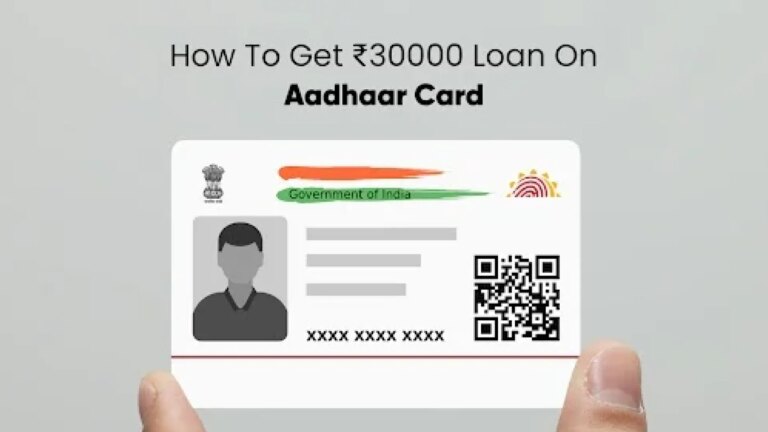
Dealing with unexpected or urgent expenses can be a major challenge, particularly for individuals who are self-employed, managing family responsibilities, freelancing, or between jobs and may not have a traditional monthly payslip. This comprehensive, expert-reviewed guide explores how you can responsibly apply for an instant ₹30,000 personal loan online by leveraging your Aadhaar Card for identity verification and alternative forms of income and financial proof, with your Aadhaar Card serving as the cornerstone of the application.
Modern, regulated Banks and Non-Banking Financial Companies (NBFCs) understand the evolving nature of the Indian workforce and no longer rely solely on a salary slip for small-ticket loans. The critical factor in securing a personal loan of ₹30,000 using your Aadhaar card is your ability to demonstrate consistent repayment capacity through documented bank statements, digital transactional data, or Income Tax Returns (ITRs), coupled with a strong credit history.
Table of Contents
ToggleWhat is a ₹30,000 Loan Based on Aadhaar Verification?
A ₹30,000 loan, verifiable via Aadhaar e-KYC, is essentially an unsecured, small-ticket Personal Loan offered by banks and regulated NBFCs, where the Aadhaar Card is used as the primary document for the mandatory Know Your Customer (KYC) verification. This process is predominantly digital and paperless, relying on the Aadhaar-based e-KYC mechanism to verify your identity and address instantly.
The loan typically falls under the following unsecured categories:
- Instant Personal Loan: A multi-purpose term loan requiring minimal documentation, primarily Aadhaar for identity and quick digital checks for income/repayment capacity. Ideal for urgent needs.
- Small Business Loan (Micro-Entrepreneur): Can serve as working capital. Lenders look at digital transactional data or business turnover instead of a salary slip, while Aadhaar verifies identity.
- Digital Consumer Loan (Short-Term Credit): A credit line accessible via an app, where the limit is based on your Aadhaar verification and credit profile.
Eligibility Criteria for a Digital Personal Loan
While the Aadhaar card simplifies the documentation process, applicants must still meet fundamental eligibility requirements set by RBI-regulated lenders to prove their ability to repay the unsecured debt.
Parameter | Salaried Individuals | Self-Employed Individuals |
Age | Minimum 21 to 58 years | Minimum 23 to 60 years |
Monthly Income | Minimum net income of ₹15,000 to ₹20,000 | Stable monthly income/business turnover (verified digitally) |
Credit Score (CIBIL) | 700+ is strongly preferred for instant approval | 700+ is strongly preferred for instant approval |
Employment Status | Employed at a private/public firm for minimum 6 months | Minimum 2 years in current business/profession |
Residency | Indian Resident with a valid bank account | Indian Resident with a valid bank account |
Key Credit Score Requirement
The CIBIL Score is the most crucial factor determining your loan eligibility and interest rate. Lenders use a risk-based pricing model.
- Preferred Score (750+): Guarantees the quickest approval and the most competitive (lowest) interest rates.
- Acceptable Score (700 – 749): Most digital lenders will accept applications. Approval is likely, but the interest rate may be slightly higher.
- Minimum Threshold (650 – 699): Challenging, but some short-term digital credit lenders might approve with a significantly higher interest rate and shorter repayment tenure.
RBI Compliance Insight: Debt-to-Income (DTI) Ratio
Your total Equated Monthly Instalments (EMIs), including the new loan, should generally not exceed 50% of your net monthly income. This is a crucial risk parameter for unsecured lending as per recent RBI guidance.
Paperless Documentation for a ₹30,000 Personal Loan
The term “₹30,000 loan on Aadhaar card without documents” is misleading. It means no physical paper documents, but it does not mean no verification. The process is entirely digital (paperless).
Document Type | Requirement | Purpose |
Identity Proof (Mandatory) | Aadhaar Card (e-KYC), PAN Card | KYC, Identity Verification, and Mandatory CIBIL Check |
Address Proof (Mandatory) | Aadhaar Card serves as primary proof; utilities (electricity bill) as secondary. | Current Residential Address Verification |
Income Proof (Mandatory) | Last 3-6 months’ Bank Account Statements (digital or PDF upload) | Repayment Capacity Verification |
Photograph | Live Selfie (via App) | Liveness check and applicant verification |
Crucial Note: An Aadhaar Card alone is not sufficient for final loan approval. It fulfils identity and address proof, but the lender still requires a PAN card (for CIBIL check) and a 3-6 month bank statement (to verify income credits/repayment capacity) for this unsecured loan.
Interest Rates and Charges: Understanding the Total Cost of Credit (APR)
Interest rates for small-ticket digital personal loans are typically higher than traditional bank loans due to the instant disbursal and higher perceived risk. All costs must be clearly presented as the Annual Percentage Rate (APR) in the Key Facts Statement (KFS).
Charge Type | Range | Compliance Requirement (RBI) |
Annual Percentage Rate (APR) | 12% to 35% per annum (includes interest + all fees) | Mandatory disclosure in the KFS as per RBI Digital Lending Guidelines. |
Processing Fee | 1% to 5% of the loan amount + applicable GST | Must be a one-time fee deducted upfront from the disbursed amount. |
Penal Charges | Fixed charge or a percentage of the overdue EMI | Must be proportional, reasonable, and disclosed as Penal Charges (not Penal Interest) in the KFS. |
Important Regulatory Note on KFS Validity: As per recent RBI mandates, the KFS must have a minimum validity period of at least three working days for loans with a tenure of seven days or more, allowing the borrower to review and acknowledge it before loan agreement execution.
Calculator for ₹30,000 Loan On Aadhaar Card
Understanding your monthly commitment is critical. The EMI (Equated Monthly Instalment) calculator helps you budget effectively using the formula:
EMI = P \times \frac{r \times (1+r)^n}{(1+r)^n – 1}
Annual Interest Rate | Tenure (Months) | Monthly EMI (Approx.) | Total Interest Paid |
16% | 6 | ₹5,257 | ₹1,542 |
18% | 12 | ₹2,750 | ₹3,000 |
22% | 18 | ₹1,957 | ₹5,232 |
28% | 24 | ₹1,634 | ₹9,216 |
Application Process for ₹30,000 Loan On Aadhaar Card: 5 Simple Steps
The application process to get a ₹30,000 loan on Aadhaar card online is typically 100% digital and can be completed via the lender’s mobile app or website:
- Initial Registration: Download the lender’s app/visit the website and register using your mobile number and PAN.
- Digital KYC (Aadhaar Verification): Complete the e-KYC process using your Aadhaar number and the OTP sent to your registered mobile number. This instantly verifies identity and address.
- Income Verification: Upload your bank statements or use the secured digital link to allow the lender’s algorithm to analyze your transaction history.
- Final Review & Disbursal: Upon instant approval, review the mandatory Key Facts Statement (KFS), accept the loan agreement digitally, and the ₹30,000 amount will be transferred to your linked bank account.
Speed: Application to Approval: 2 to 5 minutes. Disbursal Post-Acceptance: Instant, often within 1 to 15 minutes.
Common Mistakes to Avoid and Final Checklist
Avoid These Pitfalls
- Applying to Too Many Lenders: Multiple loan applications trigger ‘hard inquiries’ that can temporarily drop your CIBIL score. Apply judiciously.
- Ignoring the Key Facts Statement (KFS): Always read the KFS to verify the APR and all charges.
- Hiding Income Details: Digital bank statement analysis ensures transparency; misrepresenting income leads to immediate rejection.
Things to Remember Before Applying for ₹30,000 Aadhaar Card Loan
When considering a ₹30,000 loan on an Aadhar card, keep these points in mind:
Check Your Eligibility: Ensure you meet the lender’s criteria before applying for a loan.
Understand the Terms: Be clear on interest rates, repayment schedule, and any fees or penalties for late payments.
Assess Your Repayment Capacity: Confirm that you can comfortably afford the EMI payments without straining your finances.
Read Reviews: Look up customer feedback on the lender or platform to gauge their service quality and reliability.
Important RBI / YMYL Compliance Disclaimer
This blog is provided for informational purposes regarding unsecured personal loans, specifically the small-value ₹30,000 Aadhaar Card Loan personal loans.
- Zype is a digital lending platform partnered with regulated Non-Banking Financial Company (NBFC). All loans are processed and sanctioned by the partner NBFC in strict compliance with the Reserve Bank of India (RBI) Fair Practices Code and Digital Lending Guidelines.
- Borrower Disclosures: The final terms, including the Annual Percentage Rate (APR), total loan cost, and detailed fees, will be explicitly and transparently disclosed to you in the Key Fact Statement (KFS) before the loan sanction, as mandated by the RBI Digital Lending Guidelines.
Responsible Borrowing: Personal loans are subject to credit risk. Failure to repay installments may negatively affect your credit bureau score (CIBIL score). You must always borrow only what you can comfortably afford to repay.
Frequently Asked Questions
Is Only an Aadhaar Card Sufficient for Final Loan Approval?
No. While the Aadhaar card is 100% sufficient for e-KYC (Identity and Address Proof), it is not enough for final loan approval. Since the loan is unsecured, lenders require a PAN card (for a mandatory CIBIL check) and your last 3-6 months’ bank statements (to verify income/repayment capacity).
What is the Maximum Tenure for a ₹30,000 Loan?
For small personal loans, the tenure is typically shorter than large loans, ranging from 3 months up to 24 months (2 years). Some lenders may offer longer tenures up to 5 years (60 months) depending on your credit profile, but a shorter tenure is generally recommended to minimize total interest paid.
Can I Get a ₹30,000 Loan with a Low CIBIL Score (e.g., Below 700)?
Yes, but it is challenging and expensive. While banks typically prefer a score of 750+, some digital fintech lenders and NBFCs may consider applicants with a score as low as 650. However, this will almost always result in a significantly higher interest rate (closer to the 30-35% APR range) and stricter repayment terms.
Is Collateral (Security) Required for a ₹30,000 Personal Loan?
No. A ₹30,000 personal loan is a type of unsecured loan, meaning you do not need to pledge any asset or collateral (like gold, property, or a car) to secure the funds. The loan is approved solely based on your creditworthiness and repayment capacity.